I came across this article for a book that was coming out in 2015 (a simpler time before Covid). The premise was asking the question, does knowing what’s coming really prepare me for it? Trigger warnings are showing up all over the place as a way to warn people that what’s coming may be hard for some to see, hear, or read. (There are studies that also show this warning doesn’t actually help)
The most profound quote, to me was this:
“And what we learn about ourselves in those moments, where the trigger has been squeezed, is this: the past is not dead. There are things that wait for us, patiently, in the dark corridors of our lives. We think we have moved on, put them out of mind, left them to desiccate and shrivel and blow away; but we are wrong. They have been waiting there in the darkness, working out, practicing their most vicious blows, their sharp hard thoughtless punches into the gut, killing time until we came back that way.”
Neil Gaiman
Well, that’s a gut punch… and yet, it’s so very true. The past cannot be put away, forgotten, or ignored. It must be gone through. There is no bypass on this highway.
There is an element of choice as to when any of us choose to live through any moment of life. We can live it in the moment, 10 minutes from now, 10 years or more. (My personal favorite is “after I’ve cooled down.”) The trouble is, the longer we take to address it (i.g. “live through it”), the more stuff we can pile on top of it. Then we have to dig down through all of that stuff to get to the base issue. Ugh, it’s lots of work, and many therapists will tell you the work isn’t easy but so worth it.
The good news is, any day is a good day to start. It’s going to hurt, and it’s going to be uncomfortable… it was on day one, and we have to start there to get to day 2. BUT, I promise it will get better. We learn more about ourselves each time. We gain perspective. We bring the wisdom we learned along the way into the fold of this discussion. We grow. We love. We forgive (ourselves and others). We remember. We also honor the memory of those we love but lost along the way.
There are many rituals for honoring and mourning the dead. There are funerals, wakes, burials, shrines, etc… Among all of this it is easy to lose ourselves
A colleague wrote about how she made a commitment to herself during a particularly difficult time in her life. She made a ceremony out of it with flowers and a ring to wear and remember this commitment. I thought this was fantastic! This is something we should do in the midst of our grief – make a commitment to tend our minds, bodies, and souls.
Take time to make one of the rituals for yourself. You are worth self-love and self-care during mourning… especially during mourning. This can be a time to commune, or feel the presence, of your loved one. To talk out loud with them and share everything you’re thinking and feeling.. It’s a time to feel every emotion you have without restraint and without fear of others’ opinions.
Some ideas for a self-care ritual:
starting (or continuing) therapy
cooking a special meal once a week
going to a special spot you shared
walking in a cemetery
hear me out… no one bothers you in a cemetery.
no one will think twice about seeing you sobbing
the grounds are well-maintained and beautiful
swimming
writing
painting/drawing
turning on the music and having a private dance party
Don’t limit yourself to my ideas – do what makes your heart sing!
There will seasons of grieving with others and then seasons of grieving alone. They are both important in the balance of life. The important thing is that you continue to engage with your life while remembering, honoring, and mourning your loved one.
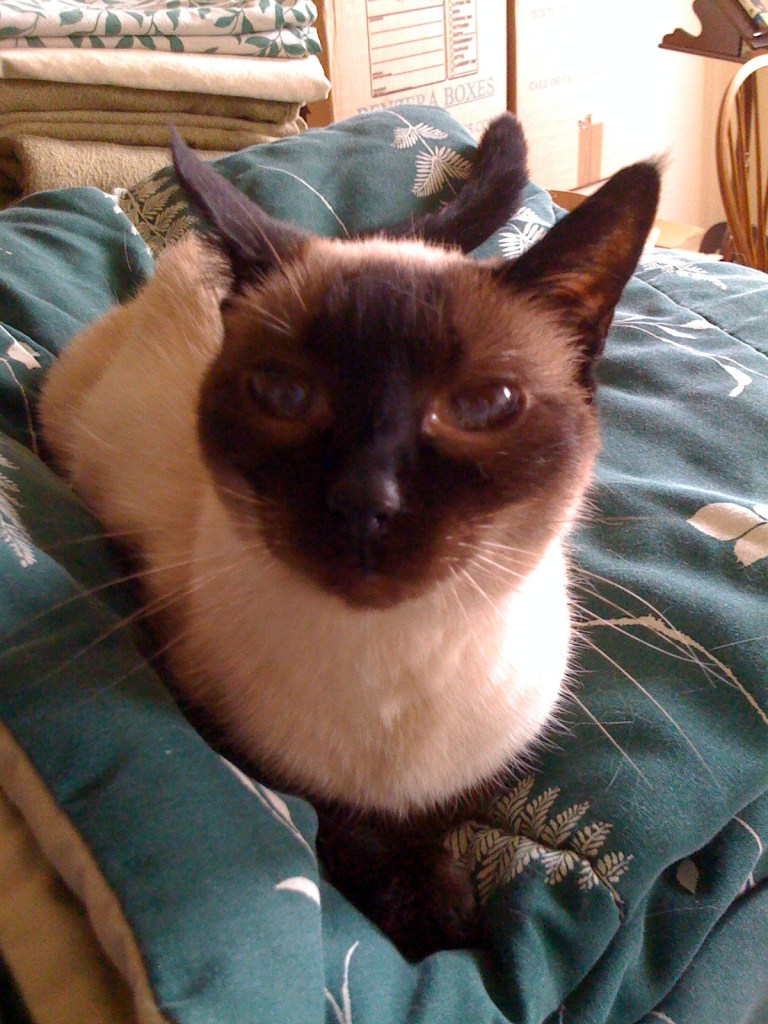
This is Diva, the Siamese, and Oberon, the Norwegian Forest Cat, who were my first two pets I had as a (mostly almost) adult person. In fact, I acquired companionship of these two just slightly before I came out. They lived with me in nearly a dozen apartments, four states, a couple of relationships, three college degrees and the first decade of my marriage to Darrick. They were my constant companions, furry little confessors, crying attendants and many days, they were the only beings on the planet I wanted to interact with. They kept me grounded and responsible at times when the *last* thing I wanted to do was adult; when I could barely take care of myself – I had to pull myself together enough every single day to feed them, take care of their litter box, give them love and attention and brushings and playtime. The very first time I brought Darrick home, they *both* wanted to be in his lap, something neither of them were apt to do with anyone, especially Oberon. I was so very lucky to have them both live past the age of 20.
Diva was the first one to leave. I loved both cats, of course, but she was extra special. Clingy, vocal, particular, demanding and always had to tell me about her day. Her kidneys failed, and we had the experience of several weeks of expensive cat food she didn’t want to eat, and weekly saline subcutaneous injections, leaving an odd and awkward lump at the scruff of her neck. Darrick was a huge help, holding her and comforting her while she *loudly* complained about the indignity of her situation. Finally, one day, she could not make it up the stairs and it was time to do what all pet owners dread, and bring her to the vet to ease her passing. I held her, and Darrick held me while the vet put her to sleep and to this day, I cannot talk about this or write about it without crying. It felt too soon, even though she was nearly 21.
At the end of his life, Oberon had gone stone deaf, and this gave him a measure of peace and tranquility that his ordinarily skittish personality had not allowed previously. The couple of years he had without Diva were peaceful as well, as her demanding, even bullying of him stopped. He could sit in whatever chair he wanted, undisturbed. He grew more and more frail, ate less and less, and though there was no specific thing we could identify wrong with him, the morning came when he did not want to get out of his box to even get his breakfast. Darrick was away on a trip and had said goodbye to him several days earlier. By this time, we had made it to Chicago. The vet there said that Oberon had lived twice, reaching 22 years of age. By myself, I held him as he closed his eyes for the last time. As with Diva, I cannot write about this without tearing up.
Oberon left us in November of that year, and we went through a miserably quiet Christmas with no cats – the first time I had not had pets in half a lifetime. The house was empty and Darrick and I knew that we simply did not like being petless. Fortunately, the shelters are full of furry friends just waiting for a new home, and in the spring, we brought Merlin and Morgana home to live with us. It’s now been a decade of adventures with these two, who are now 13 years old and beginning to slow down.
Grief is a funny thing. The immediate, sharp pain of the loss does fade over time. We get new pets, and without judgement or jealousy or any concern at all move into our lives and our hearts. But here I am, a decade later, contemplating the lives of the previous two cats I shared my life and house with, in tears. And, you know what? That’s ok. The love and companionship I have with Merlin and Morgana does not diminish in any way the time I had with Diva and Oberon. Crying over pet friends lost years ago is simply evidence of the absolute, unconditional love they have for us. My hope is always that we get past our human embarrassment about grief, and allow ourselves to feel what we feel when we feel it. It is, after all, what makes us human. So, give your pets a hug. Cry for the ones who have left. Don’t wait too long to open your home to a new furry friend when the time comes – there are too many who need us to help them. – The Rev. Dr. James J. Olson, Weymouth, MA
I am happily out, but it wasn’t always this way. I currently have an amazing partner, but it wasn’t always this way. I have an amazing, accepting family, but it took some time to get there.
Before having all the amazing things that I have right now, all I had was two little dogs, Brooklyn and Remington. Brooklyn left me after only a couple of years, and I can no longer remember the hurt that I felt when he left me. Remington lived with me for much longer.
Remington lived with me when I decided that I was no longer going to hide who I was. He lived with me when I finally came out to my family and helped me deal with the anger I had inside. He lived with me when my family and I were finally able to talk about it and shared in my hopes for the future. He was there for me when I met my first love and then when he broke my heart. Remington was the first one I told when we had the opportunity to move out of Wisconsin across the country to Washington. This little pocket beagle made the 1,700+ mile drive with me to our new home. He was also with me when I decided to have my partner move in with us. This little dog has been with me during so many ups and downs in my life. When I thought I had no one else he was there. When I thought I couldn’t do another day, he helped me get out of bed because he needed a walk and food. This made losing him super hard for me.
I think when someone that is LGBT has a connection with a pet, it is different, and the loss of the pet hits harder. So, during Pride month I not only think about the people who have paved the way for me but also the pets in our lives present, past, and future that help us continue to get out of bed to keep fighting for a better future.
Ryan Frazier, BS, LVT
These pets give us unconditional love when during a time we may not have that for ourselves. Knowing that love is always there can be a light in the darkness that can keep you going.
Happy Pride Y’all! Don’t forget to adopt not shop!
In the support group, I often talk about pizza. To me, it is one of the most perfect foods. It can be made in so many ways that it’s accessible to everyone, and there are endless combinations for the toppings.
Also, it’s one of my personal favorite foods, so I just like talking about it.
Recently, I had an experience with pizza that fits so perfectly with grief that I knew I needed to blog about it.
My local grocery store, like so many others has a deli and pizza area. For a reasonable price, I can get a decent pizza in about 10 minutes… and I can shop while it bakes! Perfect! I placed my order, did my shopping, and made my way to checkout. As I’m loading up my little treasures on the conveyor belt, I noticed my pizza was missing. The bagger kept loading items into the bag, and I thought with horror, “NO! They’re gonna crush the box! Cheese. Toppings! Mayhem on the pizza box!” I wasn’t buying anything too heavy, so I figured I should just calm down. I’m stressed because I’m hungry and I can practically taste the pizza from the smell.
Something happened with the transaction, and we needed a manager/supervisor to come help. No problem – I’ll just grab one of my slices! Wait… what is this new horror? The pizza box was put in the bag on its side. ON. ITS. SIDE! I held out hope, but it was quickly crushed by opening the soggy box and finding absolute mayhem inside. All the warm gooeyness had slid off! I was livid, and they bagger didn’t seem affected. He didn’t even look at me. I was so hungry, and I was trying so hard to reign it all in. While waiting for the supervisor to come by, I walked back over to the pizza area, with the cheesy sadness contained in a pizza coffin. “It happens at least once a week,” he said to me as he made me a new one.
I wanted to scream. I wanted to cry. I wanted someone to hurt because I was so dang hungry, and my dreams were thwarted by what I perceived to be callousness for knowing how pizzas should be treated! Does he have no respect for the craft of pizza?! I wanted to laugh at how ridiculous it is to consider a pizza bagged on its side. Why didn’t I check sooner – maybe it could have been saved? I should have gone to another line – better yet, I should have used self-checkout. I know how to respect a pizza. I thought about posting it on social media and getting support from all the other people in my life who have lost a pizza to sideways thinking. Oh the emotions that rolled through me.
After I got in the car with my new pizza (comped for the inconvenience), and got a slice in me, it dawned that I had just experienced pizza grief. Stay with me here – nothing about my experience is different than the grief anyone of us experiences. Sure the grief over my pizza is not the same as losing a loved one… but I still experienced it as a loss. I had expectations and I had hung (short-term) dreams on experiencing it. It’s not the same as losing a family member, pet, friend, or anything else… but I still experienced loss.
What kept me from losing my mind was the practice I have with other losses in life. Once I realized what was happening inside of me, I could experience it without letting it control me. I didn’t take the anger out on that bagger. I didn’t start crying to a point I felt out of control. I didn’t shut down. I could tell myself a story of loss that involved coming out the other side… and it involved a new pizza.
All of our experiences contribute to the stories we tell ourselves. They shape how we handle the same experiences in new ways, as well as all new experiences along the way. I’m confident you have your own pizza grief story to share. It’s a real experience of loss with a dash of humor, a pinch of perspective, and a schmear of hope; never forget it’s still yours and a reflection of where you have been, where you are now, and where you are going.
… and don’t forget to save a slice for a companion along the way!
This post comes from “The Raptured Spleen” and was posted 4 May 2023. I saw many of my colleagues respond and repost this – it struck at the heart of where the science and art of their profession intersect.
Sometimes it helps to be affirmed that your vet will remember you and your pet in some way. You are as much a part of their journey as they have been part of yours.
Any vet could write this, and about any, each and every week of their career I’ll bet.; but most often it does not get mentioned, and can’t be shared or understood. And if I might shed a tear whilst I type this, remember these words aren’t just mine, they belong to everyone in this profession of ours who will all feel the same as they read. And every vet, vet nurse, receptionist, student – any colleague amongst our whole team who share a practice staff room will recognize their place in this tale, many, many times over – be it a different place, different pet, different name, this story remains ever the same. Here goes:
You were sat very quietly in the corner of the waiting room, head tilted down to the greyhound entwined round your legs and chair. A picture of close companionship; both of an older generation, quietly dignified and by nature uncomplaining. I called both your names – pet’s name, your surname- you both rose to your feet as one. And as I introduced myself, we shook hands in greeting; your eyes met mine and silently screamed a plea of hope.
In the few stoic steps towards the consult room door, the issue was plain to see; a right hind leg that could bear little load, with thigh muscle already thinning.
Just a few short weeks from first flawed step to this but already you’d noted some weight loss – you shared that part with a catch in your voice, you knew it was no small thing. Then, as I listened, and you released the flow of your concerns, like an unbearable burden sliding from your shoulders, you shared some more.
She was your wife’s dog really; and it had been a year and a half since you lost her. It was a short statement that seemed to escape from you; coming at a little rush.
“It’s just the two of us now, old girl”
The best I could manage was ‘I’m very sorry to hear that, sir’. It really didn’t feel like enough. The truth is my mind was already a few steps ahead – moving along a pathway that I wished would have other turnings or exits besides the one I felt loomed ahead.
I bent down and talked to her, explaining for you both what my fingers were finding. In the past you’d had another dog, different breed, similar signs, and a diagnosis treatable with surgery. It felt cruel to say the knee was stable, and to pull that rug of hope away from under your feet.
The silent wince as I felt round her hip echoed around the small room. There was little else wrong, no flaws in her lean and muscled form, a testament to your care.
I stood, and we spoke, and I saw you were ahead of me as I introduced an ugly word as gently as I could. Our possible diagnoses still include some alternatives, a likelihood is not for sure. Radiographs will guide us more but in outline we have some options; it’s a personal decision which of these you choose and if any of those choices were wrong we wouldn’t offer them; but what’s right for one owner may be uncomfortable for another, and that is OK too. It’s my job to let you know all your options, and I’m happy to help guide you too. That part of the discussion I’ve said many, many times before but its never an automatic flow; I know my words, however gently voiced, will feel like a pounding sledgehammer and so there’s spaces and pauses, awaiting and detecting your permission to move on to the next.
What’s right for one owner may be uncomfortable for another, and that is OK
Some formalities of paper and pen, a carefully written phone number; a guide of when we’ll know more and a promise it will be me calling you soon. You knelt to give her a stroke and a pat; unfussy, undemonstrative but a truly sincere farewell.
Nurses and I worked together, a catheter gently placed, cradled once sleepy to take the pictures we needed.
We don’t need to dwell on those radiographs, nor to name the condition involved. Its enough to say as the digital image scanned onto the screen, our shoulders all dropped as one.
The phone was just a few feet away but I waded slowly towards it; and flumped on the stool, paper sheet in hand. I checked the names, and actually your patient’s gender too, before making the call. It may be irrelevant to this diagnosis but a slip at such a key time would convey a hurtful flippancy, and leave an unpleasant memory to linger. Its a small thing but actually a big thing, to ensure all language is respectfully correct.
There is a flow to any conversation; you’d clearly allowed yourself the return of a little hope at the outset, and it was my horrid task to quash it, as gently but clearly as I could. It’s not time for cutesy euphemisms that may be misleading, but nor is it time for alienating ‘medicalese’. Once the situation was clearly understood between us, and we moved on to your choices, you shared some more of your wife’s passing, sadly a very difficult time.. You wanted no part of that for your pet, your resolve to honour her with a gentle and comfortable passing was resolute, admirable and courageous. Yes, courageous – as you were prepared to lose her precious company from your life sooner, in order that she might not suffer any further discomfort at all. You checked she was still asleep – indeed – and just said whilst it would be nice to have a last farewell, its her who comes first, so please, now. I thanked you for your decision; and yes, I would hope I’d have the same courage to do the same for my own.
We said farewell, and I shared the news with the team as I drew up the injection. That part ever so practiced, and we held her for you as the anaesthetic deepened to a final conclusion.
Later, you came to collect her and I met you at your car round the back. Incongruous ‘thank yous’ and handshake exchanged again; once more I articulated my respect for your courage, hoping that by that repetition and by quiet affirmation and eye contact that would become part of your lasting memories to carry with you once this day was past and gone. We carried her with stretcher and blankets to lay her in your car, just as you wished.
And as you turned away finally to get in the drivers seat I saw your chin slightly wobble then catch back, and honestly sir, I’m just amazed at your strength throughout.
I’m amazed at your strength throughout
I know these days and weeks ahead will be difficult; I just hope we’ve done everything we possibly can to make today and those days that await ahead even just a little easier to bear and endure.
Now, that’s just one vet’s story of one patient, in one day, at one practice. Very little of it involved clinical training or medical expertise. Most vets will have done the same, or very similar, most weeks if not most days.
In fact, each day will bring a collection of cases where humanity, empathy and care will be vital to an outcome that we can all take pride in; and as I said at the beginning, these words might be mine today but this story, albeit with slight differences, twists and turns, belongs to all of us in this profession.
It’s not just your pet’s care that your vet, and their practice colleagues, takes into their hands.
When I start talking about the horizontal and experience of grief, most people think I’m talking about the rollercoaster of emotions that comprise the feelings of grief. It’s completely reasonable to assume this, but I’m going to use it in a different sense – what you do alone and what you do together.
In my previous post, I talked about when people in a relationship experience grief differently. This time I’m going to explore a different way to view this intersection.
The horizontal (linear) experience
This is best described as the chronological experience – the passing through time. This is the experience each person travels individually. I like to think of the grid on a globe – the latitude lines are parallel, so they never touch. In this way, you have your life experience that only you have encountered. Others may have encountered similar things as you, but only you have experienced them in a specific order and valued them the way you have. This is also how we experience time; it starts at one point and travels to another.
The linear (vertical) experience
This is probably best described as the interactions we have with others. Have you ever seen athletes after a game? The form 2 lines that run parallel to each other, and then they stick out their hands to slap or fist bump. When they stick their hands out to make that connection, that’s part of a vertical experience. Going back to our globe, the longitude lines eventually meet at the poles, and we eventually need more than our own thoughts and feelings. It’s going to something more than just ourselves; this could be conversing with others, interactions with a deity, attending support groups, communing with nature – and experience where the sum is greater than the parts.
True, there are introverts and extroverts out there, and we all gravitate to one of these experiences as a home base where we recharge and prepare to face the day before us. However, we cannot do only one without the other. Humans are meant to be in community, and I have never seen a need for a community more than a moment of grief and hardship. As you look at these options, see which one is your home base. Try dipping your toe in the other one and see how it stretches you into greater, and deeper, healing.
Everyone has a different love language. (If you want to know yours, click here!) This can also translate into having different needs in grief. So what do we do when people in the house grieve differently?
Acknowledge the differences. The first step to any change is recognizing things are out of sync.
Have an idea of what you may need. You are not locked into this – you can change at any time, you are constantly evolving being after all!
Ask for what you need and don’t need. Want a hug? Let people know that what you really want. Hate hugs but love an email check in? Let people know that too. People want to support you, but they don’t want to add to your hurt.
Listen to what others around you need. You may want to talk it all out until you feel some relief, but your loved one just wants to be alone to process. Grief and recovery are not one size fits all.
When your needs don’t match up, give permission to find outlets. For the talker, grant that person permission to talk with other people who can listen. For the introvert, grant that person uninterrupted time. Do you need permission? Not really, but it is a kind and loving gesture to honor the wishes someone expressly requests.
Set time aside to check in and make sure what you’ve been doing still works. Remember that you’re not locked into just one method of care, so you’ll need to check in from time to time and make adjustments as needed.
Find common ground. Find things to do together. Have a meal. Watch a movie. Binge watch a multi-episode TV show. Lay in bed while each of you scroll through social media. Being near each other will lead you back to the conversations and moments to keep the threads of your relationship tapestry strong.
It’s okay if you need different things in grief than other people in your network of support. You’re different people with different pasts.
I would like to erase this phrase. Here’s what I really dislike about it – it takes away your agency. You are in charge of your healing, and I believe you deserve every bit of credit for what you do. Working through grief is not for the faint of heart. You may not feel it right away, but I know every step you take on your journey of healing took energy and effort on your part. It’s like learning how to breathe on your own again, and I don’t like anything that takes that agency away from people.
It’s also inaccurate. When there is a cut on the skin, it is not time that heals your wound. It’s not even someone kissing your boo-boo. (Sorry Mom! It still helped.) Ask anyone in medicine and they will tell for far too much about how skin repairs. (I highly suggest you do not ask this question while eating.) Here’s the very short, non-scientific version: your skin cells use energy to replicate while you blood cells create a protective clot, or scab. Once the skin cells have essentially done the repair and knitted back into a skin barrier, the scab comes off. Sometimes the skin is tender, lighter, or even scarred – thus a reminder of what we have survived and overcome. Your body is incredible when it comes to healing, but it is you and your body healing – not time.
Time is the venue through which your body accomplishes healing.
So, I encourage you to claim your agency. Use your time to care for your body with good sleep and proper nourishment. Use your time to care for your mind through therapy, group sessions, and meaningful conversations with those in your life. Use your time to care for your soul by practicing (or starting) spiritual practices such as religious worship, yoga, meditation, etc… Use time as the venue for your own healing. Claim your own strength because I know it’s already within you.
Yup, it’s a real thing. People feel guilty about feeling happy. Humans are strange, complex, and fascinating beings. I’ve said before we don’t experience emotions in a vacuum – we’re not just happy, sad, angry, or any other emotion. We’re never 100% pure on a singular emotion… and that’s what can make guilt and happiness so weird to interact.
I know lots of people feel guilty surrounding the loss of a pet – whether it was your decision or not. Ripples of guilt are a normal response to loss. Feeling this does not mean you have done something wrong – it means you are human. If you think of it like water, it’s usually a little trickle of a stream that flows around the edges of life – it’s there, but hardly any attention is paid to it. Then there’s this seismic shake up with loss; much like the Grand Canyon, that little trickle is a flood carving out everything in its path. Everything feels bigger and more pronounced right now.
The gap from one emotion to another is now huge. Happiness is now on the other side of that canyon. People say they feel like they should be [insert emotion] instead of happy. I get it – it doesn’t feel right to laugh when the situation is so serious. People may seem to judge us for not being sad enough. Yet, laughing can be a great thing to do! I’ve done a laughing meditation with my support group before, and they have told me it feels good to laugh, to increase the dopamine levels, and to feel a pause in their loss.
Laughing meditation (or laughing yoga) increases oxygen into the body, increases epinephrine and dopamine, boosts the immune system, and triggers the parasympathetic nervous system.
I have a lot of Irish heritage in me. While I haven’t been to a full Irish wake, I’ve seen glimpses of them as I’ve joked with family at wakes and funerals. I’ve seen the funeral marches found in New Orleans. Both of these examples honor the serious of the situation while celebrating the life still in the room – the time to cry and the time to laugh. They bump up one another. Yup, it’s uncomfortable at first, and I know it’s not for every situation… but, it is okay to feel your lungs expand to take in the air around you. It would take time to fill in the Grand Canyon with pebbles – honestly, we’d have to figure out where to find that many pebbles! So, start with a few things here and there. Start with a smile, chuckle, or a smirk and shake of the head. Laugh and cry at the same time. Happiness guilt is a marker on the journey but not the end point.










 Veterinary Chaplaincy services